
Trauma Speaks
  • Home
  • Services
    • Mental Health Workshops
    • Mental Health First Aid Kits
  • About Us
    • Meet the Team
    • Newsletter
  • Get Involved
    • Opportunities >
      • Mental Health Fest
  • Blog
  • Shop
  • Contact us
  • Home
  • Services
    • Mental Health Workshops
    • Mental Health First Aid Kits
  • About Us
    • Meet the Team
    • Newsletter
  • Get Involved
    • Opportunities >
      • Mental Health Fest
  • Blog
  • Shop
  • Contact us

General Overview

Picture

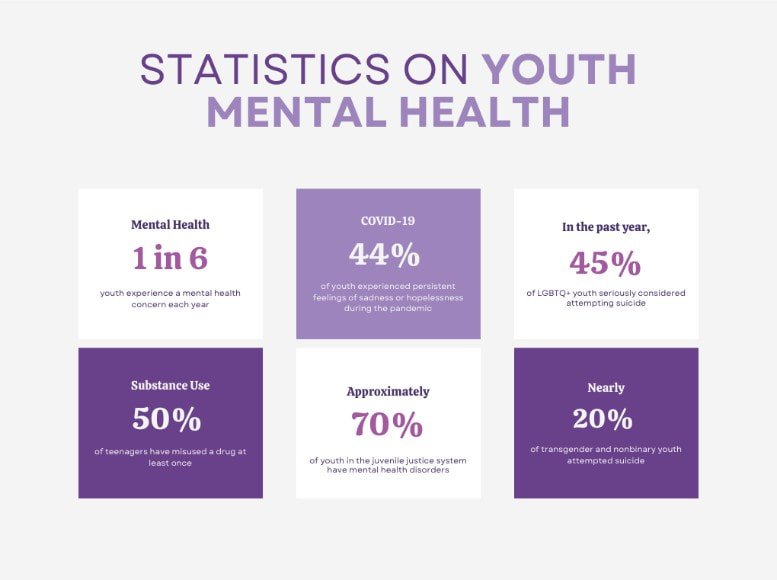
According to the World Health Organization (2021), 1 in 6 youth experience a mental health concern every year. The most common conditions include depression, anxiety, and ADHD. Some of these conditions can occur together where 3 in 4 adolescents with depression may also have anxiety symptoms. With anxiety, about 1 in 3 can also have depressive symptoms (Center for Disease Control and Prevention, 2019). During the pandemic, 44% of youth experienced persistent sadness or hopelessness, and 37% reported they experienced poor mental health (Center for Disease Control and Prevention, 2022). This can lead to higher rates of substance use where half of teens have reported misusing a drug at least once (National Center for Drug Abuse Statistics, 2020). For youth in the LGBTQ+ community, suicide is one of the leading causes of death. In the past year, 45% of LGBTQ+ youth seriously considered attempting suicide, and nearly 20% of transgender and nonbinary youth attempted it (The Trevor Project, 2022). Mental health issues can also often lead to arrests due to the stigma and inaccessibility of mental health treatment in marginalized communities. Approximately 70% of those in the juvenile justice system have mental health disorders (Castro-Ramirez et al., 2021).
It’s important to know that you’re not alone. There are many resources to help youth manage their mental health. These include:
  • The Youth Mental Health Project Club
  • The Trevor Project Support Page
  • The Jed Foundation Mental Health Resource Center
  • Kelty Mental Health Resource Center
  • Mindfulness for Teens
  • Teens Against Bullying
 
If you have any topics you want us to discuss, contact us at [email protected]

 
References:
  • Centers for Disease Control and Prevention. (2019). Data and statistics on children’s mental health. Retrieved from https://www.cdc.gov/childrensmentalhealth/data.html 
  • Centers for Disease Control and Prevention. (2022). New CDC data illuminate youth mental health threats during the COVID-19 pandemic. Retrieved from https://www.cdc.gov/media/releases/2022/p0331-youth-mental-health-covid-19.html  
  • Castro-Ramirez, F., Al-Suwaidi, M., Garcia, P., Rankin, O., Ricard, J. R., & Nock, M. K. (2021). Racism and poverty are barriers to the treatment of youth mental health concerns. Journal of Clinical Child & Adolescent Psychology, 50(4), 534–546. https://doi.org/10.1080/15374416.2021.1941058 
  • National Center for Drug Abuse Statistics. (2020). Drug use among youth: Facts and statistics. Retrieved from https://drugabusestatistics.org/teen-drug-use/ 
  • The Trevor Project. (2022). 2022 national survey on LGBTQ youth mental health. Retrieved from https://www.thetrevorproject.org/survey-2022/ 
  • World Health Organization. (2021). Adolescent mental health. Retrieved from https://www.who.int/news-room/fact-sheets/detail/adolescent-mental-health 
Substance Use Among Youth

Picture
Youth substance and alcohol use is an international public health issue. Youth involved in substance and alcohol use are more likely to develop abnormalities in brain structure and function, mental disorders, and later addictions (Tremblay et al., 2020). Poly-substance is common and youth who co-use substances tend to continue to do so as they age and are more likely to take up additional substances over time (Zuckermann et al., 2019). 
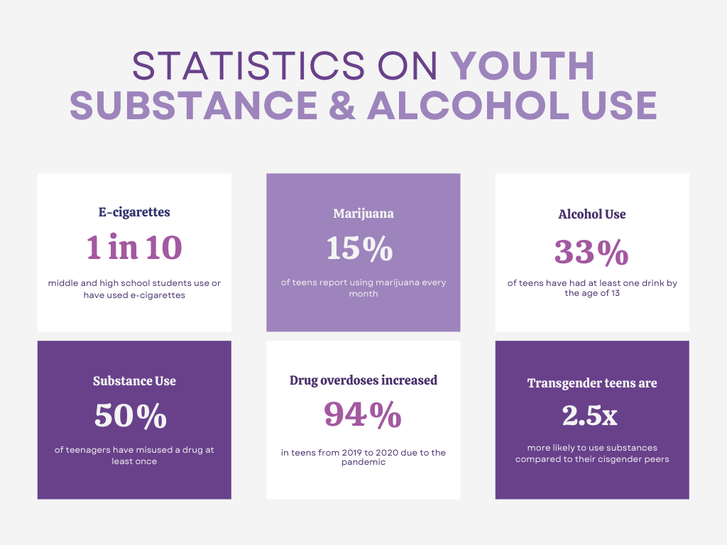
Risk factors for substance use disorder include mental health issues connected to the global pandemic, experiencing homelessness, existing in the LGBTQ+ community, and more. During the pandemic, 44% of youth experienced persistent sadness or hopelessness, and 37% reported they experienced poor mental health (Centers for Disease Control and Prevention, 2022). This can lead to higher rates of substance use where half of teens have reported misusing a drug at least once (National Center for Drug Abuse Statistics, 2020). Within the homeless population, national estimates find that 700,000 youth (ages 13–17) and 3.5 million young adults (ages 18–24) experience some form of homelessness each year. Teens who experienced abuse, ran away from home frequently, and had one or more parents with a history of drug use were found to have higher rates of substance use (Tyler & Ray, 2019). Additionally, teens in the LGBTQ+ community have experienced disparities in substance use partly due to the minority stress theory, which states that LGBTQ+ related stressors shape adverse mental health outcomes and associated coping behaviors, including substance use (Felner et al., 2020). How they cope with stressors during identity development may shape substance use disorders in adulthood. 
Although data has indicated stable or declining use of drugs among teens over many years, other research has reported a recent rise in overdose deaths among youth ages 14-18. This increase is mainly attributed to fentanyl, a potent synthetic drug, contaminating the supply of counterfeit pills made to resemble prescription medications like benzodiazepines, ADHD medications, and opioids (National Institute on Drug Abuse, 2022). It’s important to educate teens that pills purchased via social media, given to them by a friend, or obtained from an unknown source may contain fentanyl.
Barriers to treatment in this age group include inadequate awareness of mental health issues and the treatment options available, preference for self-management, stigma, lack of screening and identification, accessibility issues, and a lack of youth-specific evidence-based treatments (Hawke et al., 2019). There are increasing calls to make mental health and substance use services youth-friendly. This would include incorporating youth voices in organizations, policy, environment, service providers, and treatment services, and has implications for increased engagement, and satisfaction.
Substance Use Treatment for Teens
  • Partnership to End Addiction
  • Truth Campaign
  • SMART Recovery Teen & Youth Support Program
Helpful Resources
  • SAMHSA National Helpline - (800) 662-4357
  • The Trevor Project Support Page
  • Trans Women of Color Collective
  • Youth Engaged for Change
References:
  1. Centers for Disease Control and Prevention. (2022). New CDC data illuminate youth mental health threats during the COVID-19 pandemic. Retrieved from https://www.cdc.gov/media/releases/2022/p0331-youth-mental-health-covid-19.html 
  2. Felner, J. K., Wisdom, J. P., Williams, T., Katuska, L., Haley, S. J., Jun, H.-J., & Corliss, H. L. (2020). Stress, coping, and context: Examining substance use among LGBTQ young adults with probable substance use disorders. Psychiatric Services, 71(2), 112–120. https://doi.org/10.1176/appi.ps.201900029
  3. Hawke, L., Mehra, K., Settipani, C., Relihan, J., Darnay, K., Chaim, G. & Henderson, J. (2019). What makes mental health and substance use services youth-friendly? A scoping review of literature. BMC Health Services Research, 19(257). https://doi.org/10.1186/s12913-019-4066-5 
  4. National Center for Drug Abuse Statistics. (2020). Drug use among youth: Facts and statistics. Retrieved from https://drugabusestatistics.org/teen-drug-use/ 
  5. National Institute on Drug Abuse. (2022). Most reported substance use among adolescents held steady in 2022. National Institute on Drug Abuse. https://nida.nih.gov/news-events/news-releases/2022/12/most-reported-substance-use-among-adolescents-held-steady-in-2022 
  6. Tremblay, M., Baydala, L., Khan, M., Currie, C., Morley, K., Burkholder, C., Davidson, R., & Stillar, A. (2020). Primary substance use prevention programs for children and youth: A systematic Rrview. Pediatrics, 146(3), e20192747. https://doi.org/10.1542/peds.2019-2747 
  7. Tyler, K. A., & Ray, C. M. (2019). Risk and protective factors for substance use among youth experiencing homelessness. Children and Youth Services Review, 107, 104548. https://doi.org/10.1016/j.childyouth.2019.104548 
  8. Zuckermann, A. M. E., Williams, G., Battista, K., de Groh, M., Jiang, Y., & Leatherdale, S. T. (2019). Trends of poly-substance use among Canadian youth. Addictive Behaviors Reports, 10, 100189. https://doi.org/10.1016/j.abrep.2019.100189
Be Heard. Break the Stigma. 
© TraumaSpeaks 2017
Los Angeles, CA
ALL RIGHTS RESERVED.